Argmax
Select the single best item from a set of n items, given features correlated with hidden item scores. This is a minimalist DFL setting: equivalent to multiclass classification, but with an argmax layer instead of softmax. Useful as a minimal sandbox for understanding DFL concepts.
using DecisionFocusedLearningBenchmarks
using Plots
using Statistics

b = ArgmaxBenchmark(; seed=0)
ArgmaxBenchmark(instance_dim=10, nb_features=5)Observable input
At inference time the decision-maker observes only a feature matrix x (rows = features, columns = items):
dataset = generate_dataset(b, 100; seed=0)
sample = first(dataset)
plot_context(b, sample)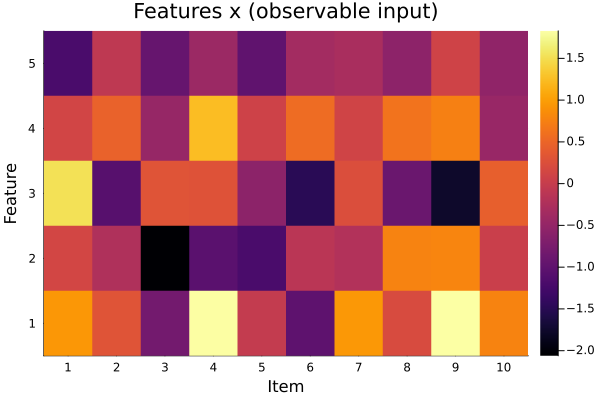
A training sample
Each sample is a labeled triple (x, θ, y):
x: feature matrix (observable at train and test time)θ: true item scores (training supervision only, hidden at test time)y: optimal one-hot decision derived fromθ
The full training triple (features, true scores, and optimal decision):
plot_sample(b, sample)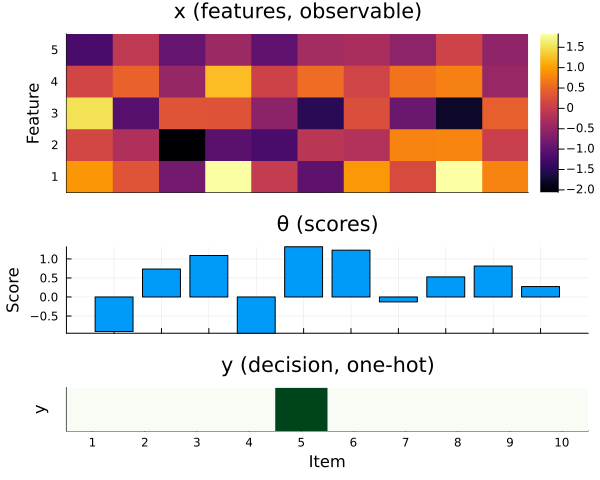
Untrained policy
A DFL policy chains two components: a statistical model predicting scores from features:
model = generate_statistical_model(b) # linear map: features → predicted scoresChain(
Dense(5 => 1; bias=false), # 5 parameters
vec,
) and a maximizer turning those scores into a decision:
maximizer = generate_maximizer(b) # one-hot argmaxone_hot_argmax (generic function with 1 method)A randomly initialized policy makes essentially random decisions:
θ_pred = model(sample.x)
y_pred = maximizer(θ_pred)
10-element Vector{Float32}:
0.0
0.0
0.0
1.0
0.0
0.0
0.0
0.0
0.0
0.0plot_sample(b, DataSample(sample; θ=θ_pred, y=y_pred))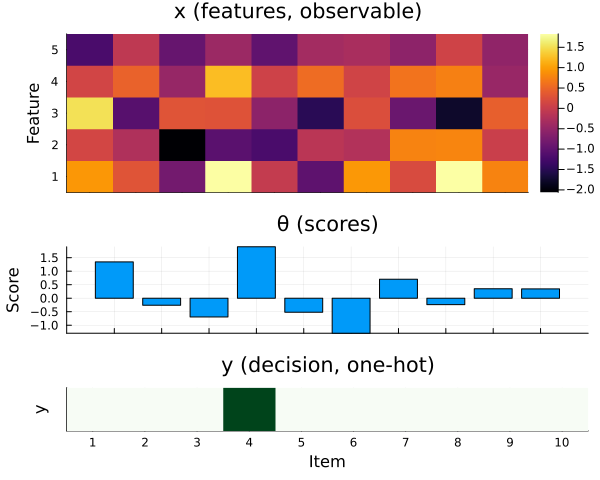
The goal of training is to find parameters that maximize accuracy. Current accuracy on the dataset:
mean(maximizer(model(s.x)) == s.y for s in dataset)0.0Problem Description
In the Argmax benchmark, a feature matrix $x \in \mathbb{R}^{p \times n}$ is observed. A hidden linear encoder maps $x$ to a score vector $\theta = \text{encoder}(x) \in \mathbb{R}^n$. The task is to select the item with the highest score:
\[y = \mathrm{argmax}(\theta) = \mathop{\mathrm{argmax}}\limits_{y\in\Delta^n} \theta^\top y\]
The solution $y$ is encoded as a one-hot vector. The score vector $\theta$ is never observed (only features $x$ are available). The DFL pipeline trains a model $f_w$ so that $\mathrm{argmax}(f_w(x))$ matches $\mathrm{argmax}(\theta)$ at decision time.
Key Parameters
| Parameter | Description | Default |
|---|---|---|
instance_dim | Number of items | 10 |
nb_features | Feature dimension p | 5 |
DFL Policy
\[\xrightarrow[\text{Features}]{x \in \mathbb{R}^{p \times n}} \fbox{Linear model $f_w$} \xrightarrow[\text{Predicted scores}]{\theta \in \mathbb{R}^n} \fbox{argmax} \xrightarrow[\text{Selection}]{y \in \{0,1\}^n}\]
Model: Chain(Dense(nb_features → 1; bias=false), vec): a single linear layer predicting one score per item.
Maximizer: one_hot_argmax: returns a one-hot vector at the argmax index.
This page was generated using Literate.jl.