Subset Selection
Select the k most valuable items from a set of n: items with unknown values must be identified from observable features alone.
using DecisionFocusedLearningBenchmarks
using Plots

b = SubsetSelectionBenchmark(; identity_mapping=false)
SubsetSelectionBenchmark(n=25, k=5)Observable input
At inference time the decision-maker observes only the feature vector x:
dataset = generate_dataset(b, 50; seed=0)
sample = first(dataset)
plot_context(b, sample)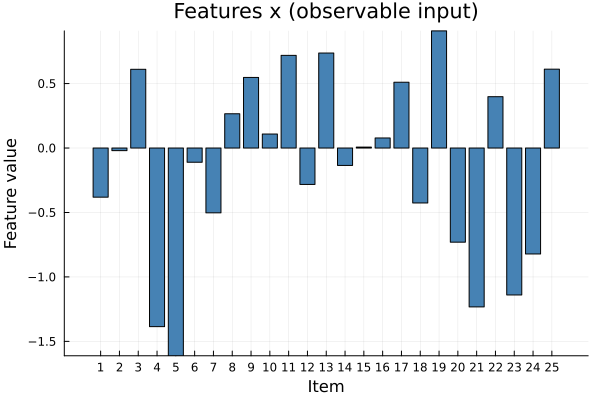
A training sample
Each sample is a labeled triple (x, θ, y):
x: item feature vector (observable at train and test time)θ: true item values, derived fromxvia a hidden encoder (training supervision only)y: selection indicator (y[i] = 1for thekhighest-value items, 0 otherwise)
The full training triple (features, hidden values, and selection):
plot_sample(b, sample)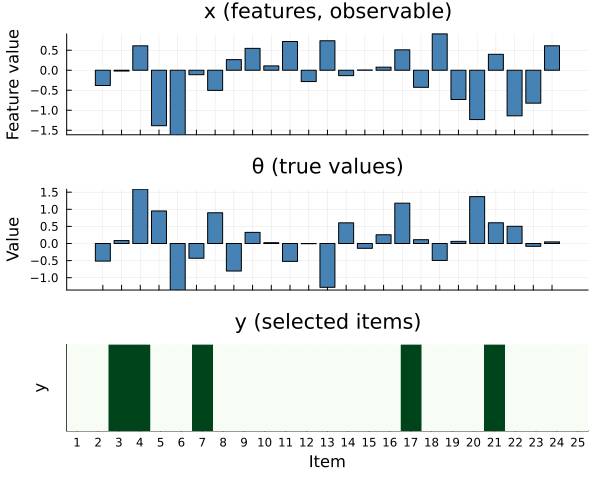
Untrained policy
A DFL policy chains two components: a statistical model predicting item scores:
model = generate_statistical_model(b) # linear map: features → predicted item scoresDense(25 => 25; bias=false) # 625 parametersand a maximizer selecting the top-k items by those scores:
maximizer = generate_maximizer(b) # top-k selection(::Base.Fix2{typeof(DecisionFocusedLearningBenchmarks.SubsetSelection.top_k), Int64}) (generic function with 2 methods)A randomly initialized policy selects items with no relation to their true values:
θ_pred = model(sample.x)
y_pred = maximizer(θ_pred)
plot_sample(b, DataSample(sample; θ=θ_pred, y=y_pred))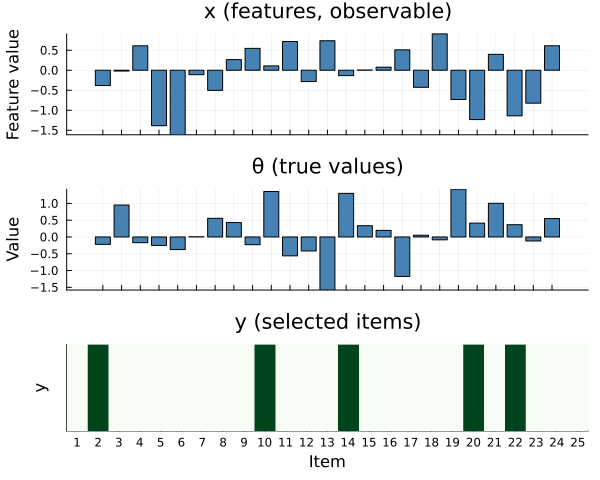
Optimality gap on the dataset (lower is better):
compute_gap(b, dataset, model, maximizer)0.9866888f0Problem Description
In the Subset Selection benchmark, $n$ items have unknown values $\theta_i$. A feature vector $x \in \mathbb{R}^n$ is observed (identity mapping by default). The task is to select the $k$ items with the highest values:
\[\begin{aligned} y = \mathrm{top}_k(\theta) = & \mathop{\mathrm{argmax}}\limits_{y \in \{0,1\}^n} \; \theta^\top y \\ & \quad\text{s.t.} \quad \sum_{i=1}^n y_i = k \end{aligned}\]
where $y \in \{0,1\}^n$ with exactly $k$ ones.
Key Parameters
| Parameter | Description | Default |
|---|---|---|
n | Total number of items | 25 |
k | Number of items to select | 5 |
identity_mapping | Use identity as the hidden mapping | true |
When identity_mapping=true, features equal item values directly (x = θ). When false, a random linear layer is used as the hidden mapping.
DFL Policy
\[\xrightarrow[\text{Features}]{x} \fbox{Linear model} \xrightarrow{\theta} \fbox{top-k} \xrightarrow{y}\]
Model: Dense(n → n; bias=false): predicts a score per item.
Maximizer: top_k(θ, k): returns a boolean vector with true at the k highest-scoring positions.
This page was generated using Literate.jl.